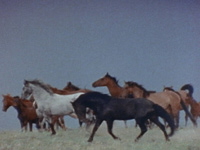
When early Spanish settlers accidentally released wild horses (equus cabalus) to the continent in the early 1500s, they returned an American original.
Although the remnants of the escaped Spanish horse are protected by the 1971 Free-Roaming Wild Horse and Burro Act, each year thousands are removed from public lands across the American West to reduce competition between horses and domestic livestock.
El Caballo documents one of the most complex wildlife management issues today. Where do modern wild horses fit in our view of the natural world?
Note: This version is shortened from the director's original 54-minute cut and was edited with educational and group screenings in mind, where length is an important factor. The director describes the difference between the two versions as follows:
"The 54-minute version of EL CABALLO includes a more significant discussion about the origins and evolution of horses in North America. It also includes a more in-depth history beginning with the 're-introduction' of Equus cabalus to North America, acquisition and use by Native Americans, and eventual capture and sale by wild horse 'mustangers.' Current management of wild horse populations on public lands is covered fairly well in both versions, but the longer version contains a somewhat more complete picture of BLM management." Doug Hawes-Davis
The short version is included on the DVD of the original version.

Grade Level: 7-12, College, Adult
US Release Date: 2002
Copyright Date: 2001
VHS ISBN: 1-56029-914-2
Reviews
"El Caballo isn't a call to action. It doesn't tell anyone what to think, and it doesn't stake out a high ground or 'right' way to manage. What it does is present a little-known controversy, backed up with a diverse array of opinionated experts, and package it with eye-candy footage that never lets your eyelids sag." Missoula Independent
"Long considered an 'exotic' species, wild horses occupy a sort of borderland, caught between the mythology of their origins and the reality of their plight today. This is the subject of a new documentary, El Caballo, by Drury Gunn Carr and Doug Hawes-Davis. Known for their hard-hitting documentary films, Varmints and Killing Coyote, Carr and Hawes-Davis approach wild horses with a lighter, albeit no less powerful touch." High Country News
"A level-headed but powerful presentation... El Caballo provides a quick education on wild horses, with
|